
Technical guide
Semiconductors: the requirements of cleaning in a sensitive environment
Particles, surface cleanliness, cleanroom compatibility: in a sensitive environment, cleaning is judged at a scale where the eye can no longer see anything.
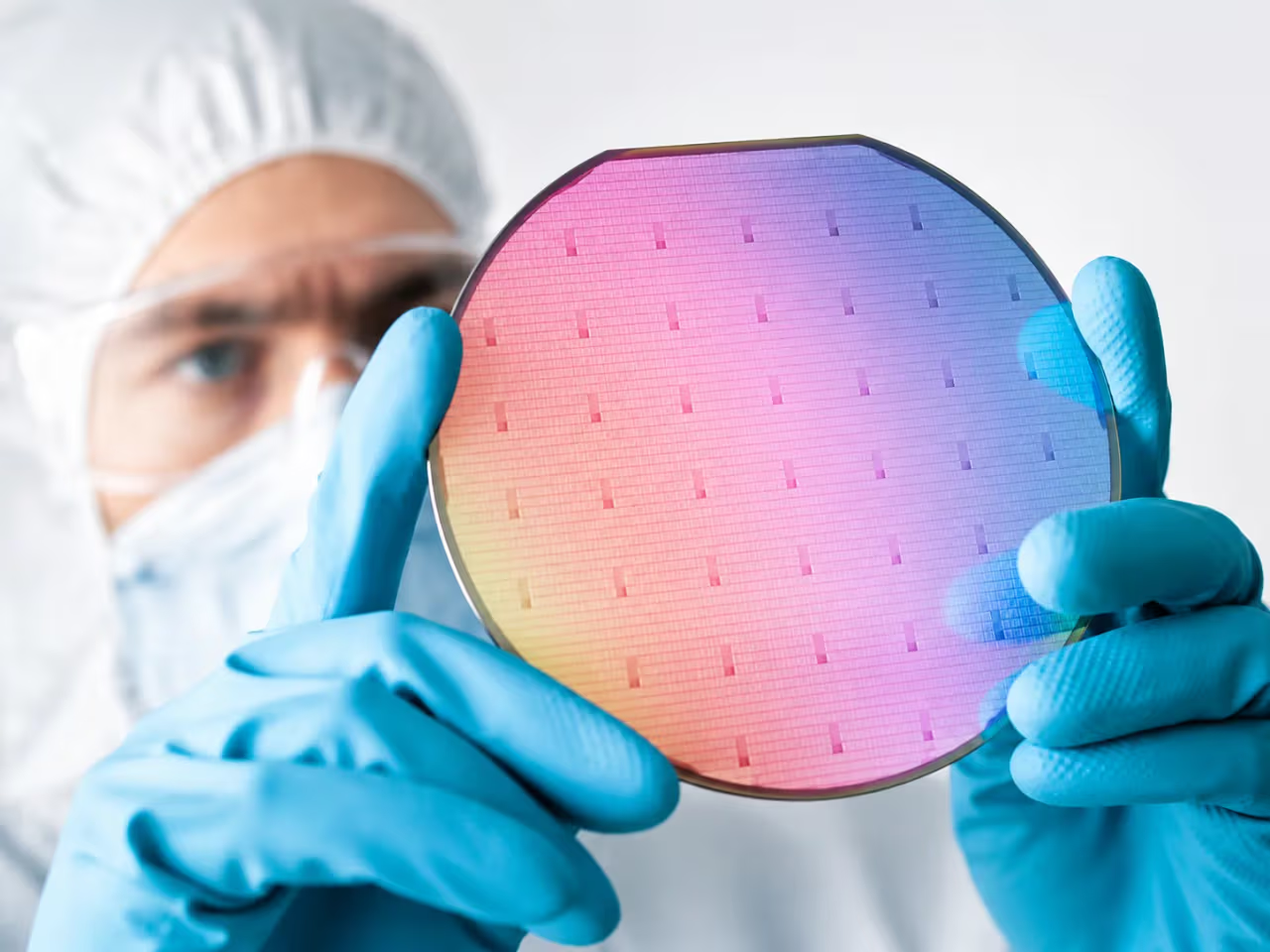
In a semiconductor environment, cleanliness is not discussed at the visible scale. A particle invisible to the eye can be enough to compromise a part or a downstream process. Cleaning must therefore be designed for a different level of requirement — and a different environment — than consumer electronics.
Cleanliness that plays out at the particle scale
Where a board is judged on flux residues, a part intended for semiconductors is judged on particulate cleanliness and surface cleanliness. The aim is not only to remove a visible contaminant, but not to reintroduce one — including via the cleaning fluid, the rinse water or the drying air.
Control the whole chain, not just the washing
- Rinse water quality: insufficient rinsing leaves dissolved traces.
- Controlled drying: avoid redepositing particles or leaving marks.
- Cleanroom compatibility: equipment and flows must respect the environment.
- Repeatability: a documented, stable process that can be monitored over time.
Related products
Frequently asked questions
How does semiconductor cleaning differ from conventional electronics?
The criterion shifts from visible residues to particulate and surface cleanliness, at a much finer scale. The quality of rinsing, drying and the environment (cleanroom) becomes decisive, just like washing.
Is the cleanroom part of the process?
Yes: in a sensitive environment, the equipment, flows and immediate surroundings determine the result. A perfect cleaning can be ruined by downstream recontamination if the environment is not controlled.
Further reading

Technical guide
Complete guide to the N29 range: cleaning technology for screen printing
Discover how MBtech's N29 range transforms the cleaning of stencils and screen printing equipment, thanks to advanced ultrasonic technology and closed-loop filtration systems.
Technical guide
How to choose a cleaning process for electronic boards?
Flux residues, solder paste, conformal coating: each contaminant calls for a different cleaning physics. A method for framing the need before looking at machines.
Technical guide
Screen printing stencil cleaning: the criteria to watch
Frequency, chemistry, drying, aperture inspection: the parameters that determine print quality and stencil lifetime.
A cleaning project to discuss?
Tell us about your parts and your constraints. Our process specialists will get back to you.
Talk to an expert